
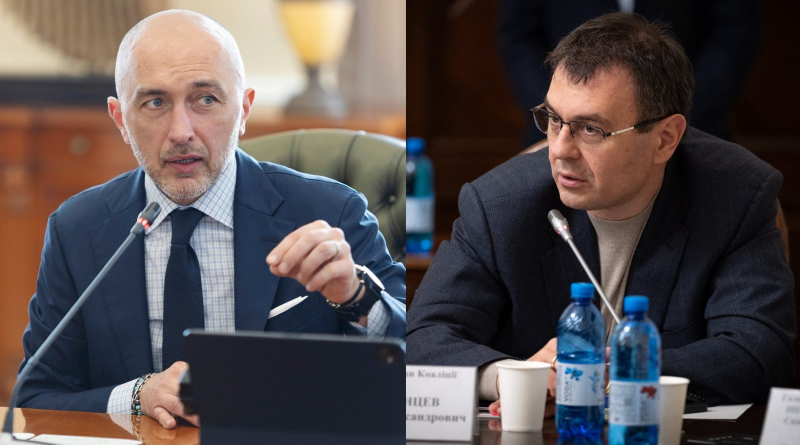
Ukraine’s Central Bank and Parliament Finance Committee Chair Exchange Public Accusations Amid Political Pressure Allegations
A significant rift has emerged between Ukraine’s National Bank (NBU) and the Chairman of the Verkhovna Rada’s Finance Committee, Danylo Hetmantsev, as both sides engaged in an unprecedented public exchange of accusations. The central bank has formally accused the influential parliamentarian of bias and politically motivated pressure, marking one of the most dramatic confrontations between monetary authorities and legislative oversight in recent Ukrainian political history. This clash comes at a particularly sensitive time for Ukraine, as the country navigates complex economic challenges while managing wartime financial stability.
The National Bank of Ukraine released a strongly-worded statement defending its institutional independence, explicitly naming Hetmantsev as a source of inappropriate political interference. According to the regulator, the finance committee chairman has been engaging in activities that undermine the central bank’s ability to conduct monetary policy free from political considerations. The NBU emphasized that such pressure threatens not only its operational independence but also the broader framework of economic governance that Ukraine has worked to establish over the past decade of reforms.
Danylo Hetmantsev, who has served as the head of the parliamentary finance committee since 2019, represents the ruling Servant of the People party and has been one of the most influential voices in Ukrainian fiscal policy. His committee oversees banking regulation, taxation, and financial services legislation, giving him substantial power over the regulatory environment in which the NBU operates. Throughout his tenure, Hetmantsev has frequently clashed with various financial institutions and has been known for his assertive approach to legislative oversight of the banking sector. Critics have accused him of overstepping parliamentary boundaries, while supporters argue he provides necessary accountability for powerful financial institutions.
Central bank independence has served as a foundational element of Ukraine’s economic reforms following the Maidan revolution, with strong backing from international partners such as the International Monetary Fund, the European Union, and the World Bank. Since 2014, Ukraine has made substantial progress in shielding its monetary policy from political meddling, acknowledging that autonomous central banks generally achieve superior inflation control and enhanced economic stability. The NBU’s evolution under former governor Valeria Gontareva and continuing under later leadership has received widespread acclaim from international financial institutions as an exemplary reform achievement. Any impression that this autonomy is being undermined could carry significant consequences for Ukraine’s relations with international lenders and its current IMF program.
The timing of this public dispute raises concerns among economic analysts and international observers.
Ukraine continues to rely heavily on external financial support to maintain economic stability during the ongoing conflict with Russia. The country’s economy contracted by approximately 29% in 2022, and while there has been modest recovery, the situation remains fragile. International donors have consistently emphasized that continued support depends partly on Ukraine maintaining strong institutional frameworks and governance standards. A visible breakdown in relations between key economic institutions could send negative signals to international partners at a critical moment when Ukraine is seeking additional funding and working toward European Union membership.
Historical context adds further dimension to this confrontation. Ukraine has experienced previous episodes of tension between political authorities and the central bank, most notably during the early 2000s when successive governments attempted to influence monetary policy for political gain. These experiences contributed to the constitutional and legislative reforms that strengthened NBU independence. The current dispute echoes concerns that some politicians may be reverting to earlier patterns of behavior, attempting to subordinate independent institutions to political objectives. Transparency International and other governance watchdogs have repeatedly warned that protecting institutional independence remains an ongoing challenge in Ukraine’s reform process.
As this conflict develops, both parties seem to be seeking validation from public opinion and international stakeholders for their respective stances. The NBU’s choice to openly charge a sitting parliamentary committee chairman with exerting political pressure is exceptionally rare and indicates the regulator considers the circumstances to have crossed a critical line. At the same time, Hetmantsev’s office has maintained that his oversight activities represent proper parliamentary duties vital for democratic accountability. The outcome of this confrontation may establish significant precedents regarding the equilibrium between legislative oversight and institutional autonomy within Ukraine’s developing democratic framework. Economic analysts indicate that achieving a productive resolution will necessitate both parties acknowledging the legitimate functions each performs while honoring established boundaries created to shield monetary policy from political interference.